.png)
ESTELLE FLOREY-CARTER: A CLASS ACT IN EVERY SENSE
- Celebrating Life After 60

- Jun 1
- 3 min read
by Alan Linq
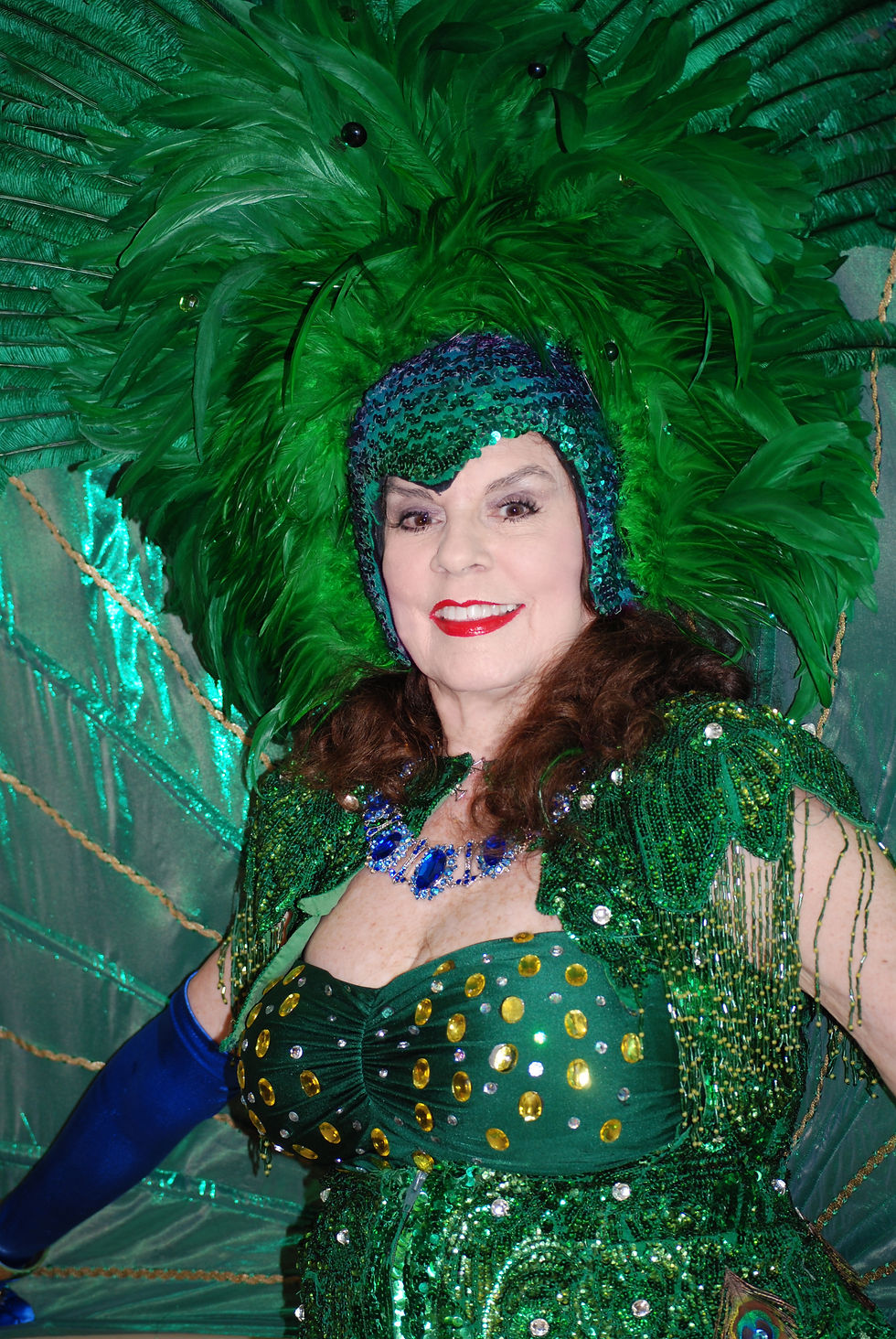
Some people find their calling all at once. Others back into it slowly, following one small “yes” after another until a life begins to take shape. Estelle Florey-Carter seems to have found hers in eight counts, a pair of tap shoes and the firm belief that if joy is available, it ought to be shared.
Growing up in Longview, Texas, Estelle was drawn early to music and dancing. She worked for her dance lessons by helping at a local studio. Before long she was teaching there, and even briefly ran it, delaying college but not the life that was already taking shape.
That life soon carried her to Kilgore Junior College, home of the famed Kilgore Rangerettes. Estelle had not been chosen as a majorette in high school, but at Kilgore, she tried again. “I got up the nerve to audition,” she says, “and I was selected as captain my first year there.”
For two years, Estelle led the Rangerettes through performances at bowl games, special appearances and even Eisenhower’s inauguration. Those years come with the sparkle of another era: meeting the Nixons, crossing paths with Robert Mitchum and Jane Russell, and waiting to perform while sitting in a stairwell with Hoagy Carmichael.
After Kilgore, Estelle attended Stephen F. Austin State University, where she graduated with a major in mathematics. Artist and mathematician may sound like an unlikely pairing, but Estelle’s career makes the combination feel inevitable. Tap requires rhythm, timing and precision. So does math…although it usually has fewer sequins. Usually.
Her professional life soon moved in several directions. She taught algebra at Nederland High School near Port Arthur, where she also served as drill team instructor. Later, she moved to Dallas and worked for John Robert Powers, teaching self-improvement and modeling for advertisements, newspapers and billboards. Marriage took her to Oklahoma, where she helped run a charm school, and then to New York City. She eventually returned to Dallas, and taught math again briefly before moving into property management.
But performance never left the room. Estelle auditioned for a senior theater group and spent nine years with Platinum Follies, eventually appearing in more than 20 theater productions.
Then came the tap company.
In the mid-1980s, a Dallas Morning News ad led Estelle to a small group of dancers, including Joy Holland Coleman, another former Rangerette. Soon the pair launched Class Act Tap Company. The beginning was humble: a rented room at a YMCA in a converted house near Inwood and Northwest Highway, a small patch of mirrors, and women pooling money because nobody had much to spare.
Forty years later, though, Class Act is still tapping. Estelle refers to it as “a dancing ministry,” performing about 100 shows each year and never charging for its performances. The company brings tap dancing to nursing homes, hospitals, community centers, veterans’ events, private celebrations and other places where music, movement and a little shine can change the room.
As Class Act celebrates 40 years rooted in Estelle’s founding vision, her legacy is not simply that she taught steps. It is that she built a place where talent became generosity, where friendship became structure, and where aging never meant disappearing from the stage.
Her advice to other seniors is direct and hard-earned: “Do what you love,” she says. “Surround yourself with your friends. Keep moving.”
That may be the whole Class Act philosophy in three short sentences. Keep moving. Keep giving. And when the music starts, trust that the next step will find you.